recession? what recession? (part-2)
(2024-Jun-11)
We’ve been predicting an economic recession for not less than 23 months in this column. The evidence keeps accumulating and it’s not different this time; it practically never is. More precisely, we anticipated the beginning of the down-turn, in mid to late 2024Q1 when the last of the helicopter-money ran out. Indeed there were indications of that coming in the dismal Christmas’23 retail data. Since that very time frame (24Q1) the baffling divergence of household surveys vs the establishment surveys, are repeatedly pointing to something amiss. The informal narrative of the latter divergence, is that the common person does not agree with the US central bank’s rosy picture of the economy. The establishment’s most recent tact is to give very optimistic data only to quietly revise by huge amounts later.
The unabated rise in the S&P005 (no that’s not a typo!) has also helped in the misdirection required to distract the pundits away from the common person’s perpetual malaise since 2023Q4.
Here is just one more indicator; the “Sahm rule”: whenever unemployment rises more than 50bp from its lowest value within the previous 12 months, we can count on the start of an economic down-turn. As you can see (albeit a coincident indicator) it’s been pretty accurate. Since last November, there has been a swing of 76bp:
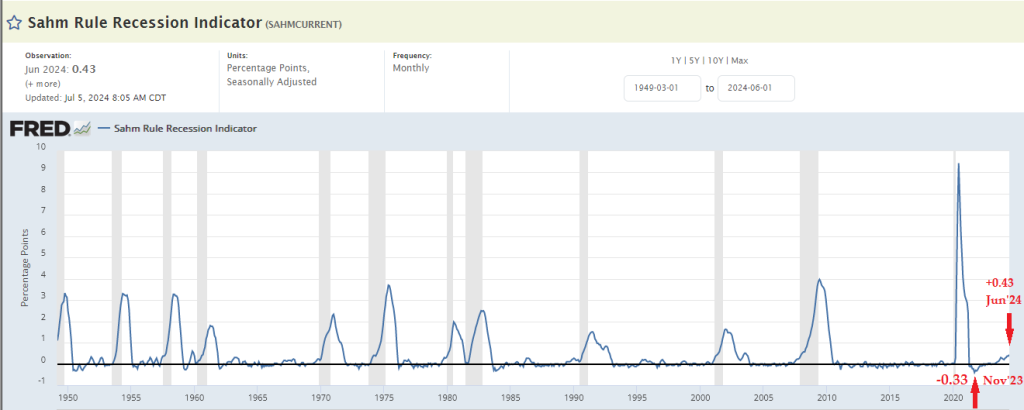
Four weeks ago, based on our indicators and a multitude of others, we put the start of the recession in the first week June 2024. Count the Sahm’s signal as just another nail.
Previously we’ve also shown historical evidence that (counterintuitively,) the stock market will not start its response to higher rates until after the lowering of rates commence. When the first drop in interest-rates does occur sometime between now and September’24, watch out for a major top in equities.
Beyond that, the lower rates (at least at the long-end) will be short-lived, and will resume the general long-term movement back to high values. Major demographic and other structural shifts will require it. Under the strain of high rates, the painful reckoning of the US debt is barely a few years away.